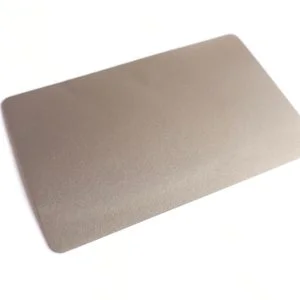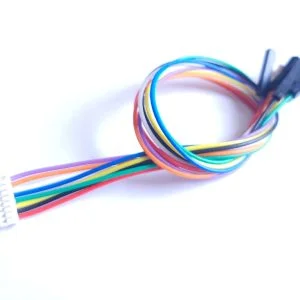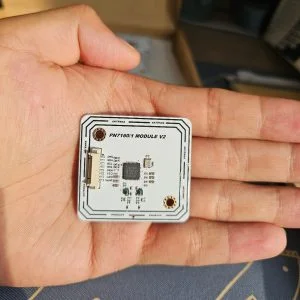
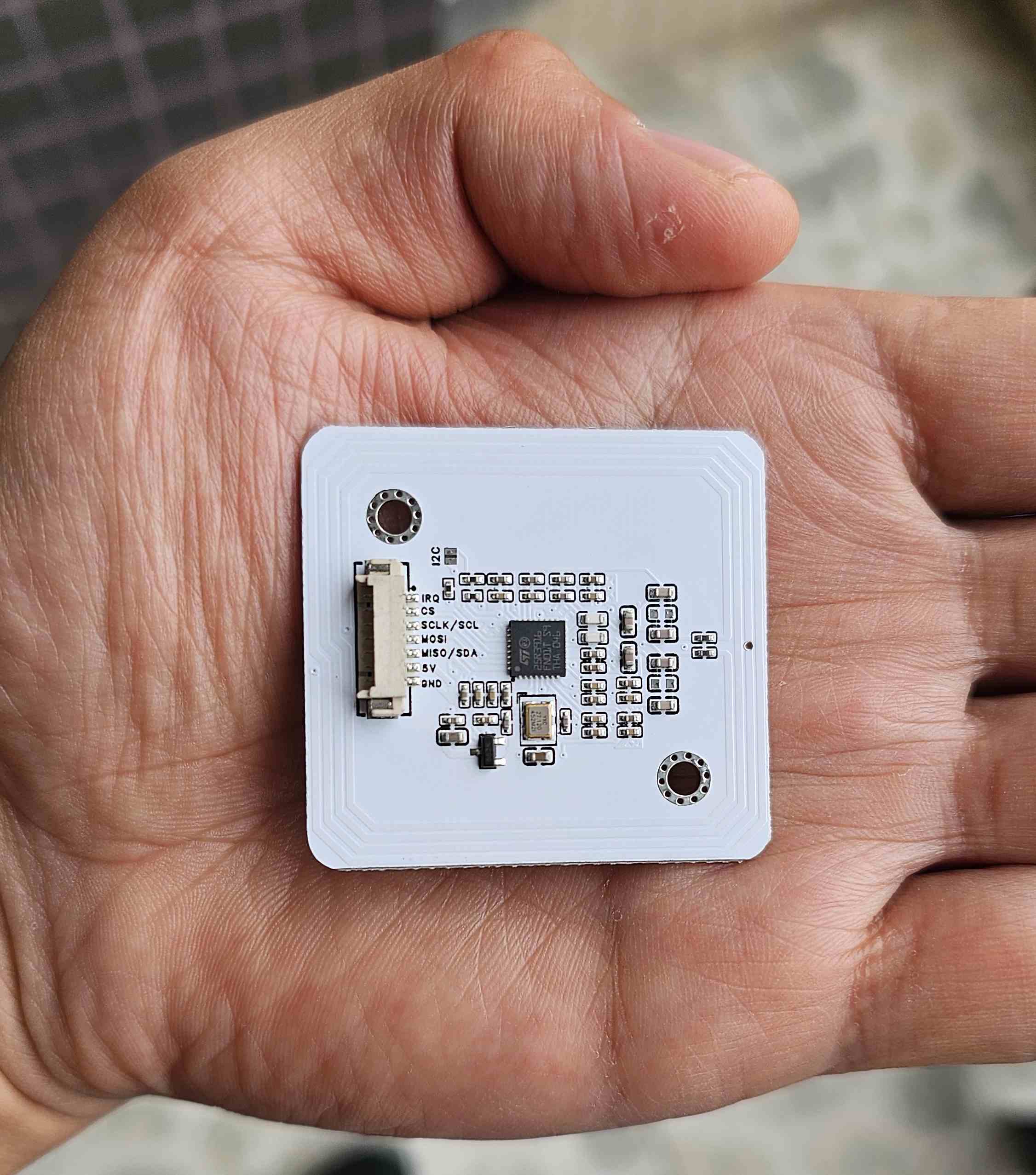
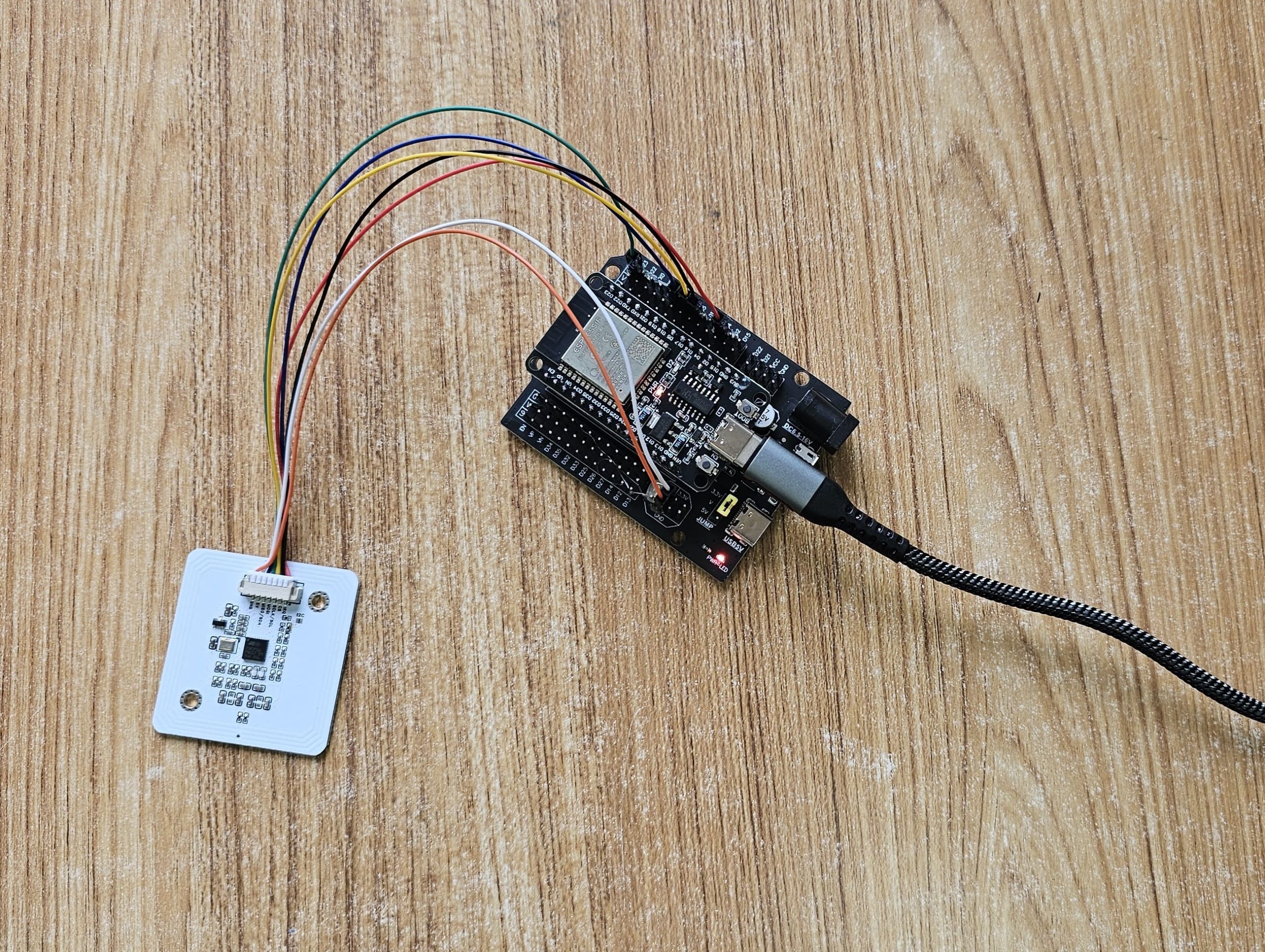
The ST25R3916 NFC Reader Module is built around STMicroelectronics’ ST25R3916, one of the highest-performance NFC reader chips available. It delivers exceptional reading range across a wide range of tag types and protocols, including ISO 15693 tags readable at over 11 cm. This module is designed for demanding applications where reading distance, protocol coverage, and signal reliability matter.
ST25R3916 vs ST25R3916B: Product Differences
The ST25R3916 NFC Reader Module and ST25R3916B NFC Module are very close at the ELECHOUSE module level. They use a similar connector style, the same 13.56 MHz NFC/HF RFID application direction, and the same ELECHOUSE ST25R3916 software family. The main difference is the reader IC generation and the B-version RF/AWS hardware setup.
| Item | ST25R3916 NFC Reader Module | ST25R3916B NFC Module |
|---|---|---|
| Reader IC | STMicroelectronics ST25R3916 | STMicroelectronics ST25R3916B |
| Chip generation | Original ST25R3916 generation | Newer ST25R3916B generation |
| Module design | Original ELECHOUSE ST25R3916 board | Very similar ELECHOUSE board design, with B-version capacitor adjustment for active wave shaping (AWS) |
| EMVCo target | EMVCo 3.0 analog and digital | EMVCo PCD L1 3.2a analog and digital |
| Active wave shaping (AWS) | ST25R3916 AWS / overshoot-under-shoot control | B-series AWS implementation with matching VDD_AM capacitor setup |
| ASK modulation depth | 5% to 40% | 0% to 82% |
| Supported protocols | ISO 14443A/B, ISO 15693, FeliCa, NFC Forum tag technologies | Same broad NFC/HF RFID protocol family |
| Host interface | SPI by default, I2C after board configuration | SPI by default, I2C after board configuration |
| Software library | ELECHOUSE ST25R3916 library | Same ELECHOUSE ST25R3916 library |
| Recommended choice | Best for existing ST25R3916 projects or designs already validated with this module | Better choice for new designs that prefer the newer B-series reader IC and updated AWS hardware setup |
Product links: ST25R3916 NFC Reader Module | ST25R3916B NFC Module
Who This Module Is For
- Engineers requiring high reading distance or multi-protocol NFC support
- Developers working with ISO 15693, MIFARE, DESFire, and other NFC technologies
- Industrial and commercial applications needing robust NFC reading
- OEM/ODM customers building production NFC reader devices
Core Advantages
- Industry-leading reading distance, up to 11+ cm on ISO 15693 tags
- Broad protocol coverage: ISO 14443A/B, ISO 15693, FeliCa, NFC Forum Type 1 to 5
- Active load modulation for card emulation
- Low-power phase and amplitude card-detection modes available at IC level
- SPI by default, with I2C support after hardware pad bridging
- Same ELECHOUSE ST25R3916 software family as the ST25R3916B NFC Module
Key Specifications
| Chip | STMicroelectronics ST25R3916 |
| Operating Frequency | 13.56 MHz |
| Interface | SPI (default), I2C (after bridging the on-board I2C solder pad) |
| Supported Standards | ISO 14443A/B, ISO 15693, FeliCa, NFC Forum Type 1 to 5 |
| Card Emulation | NFC-A and NFC-F card emulation at IC level |
Pinout and Interface Notes
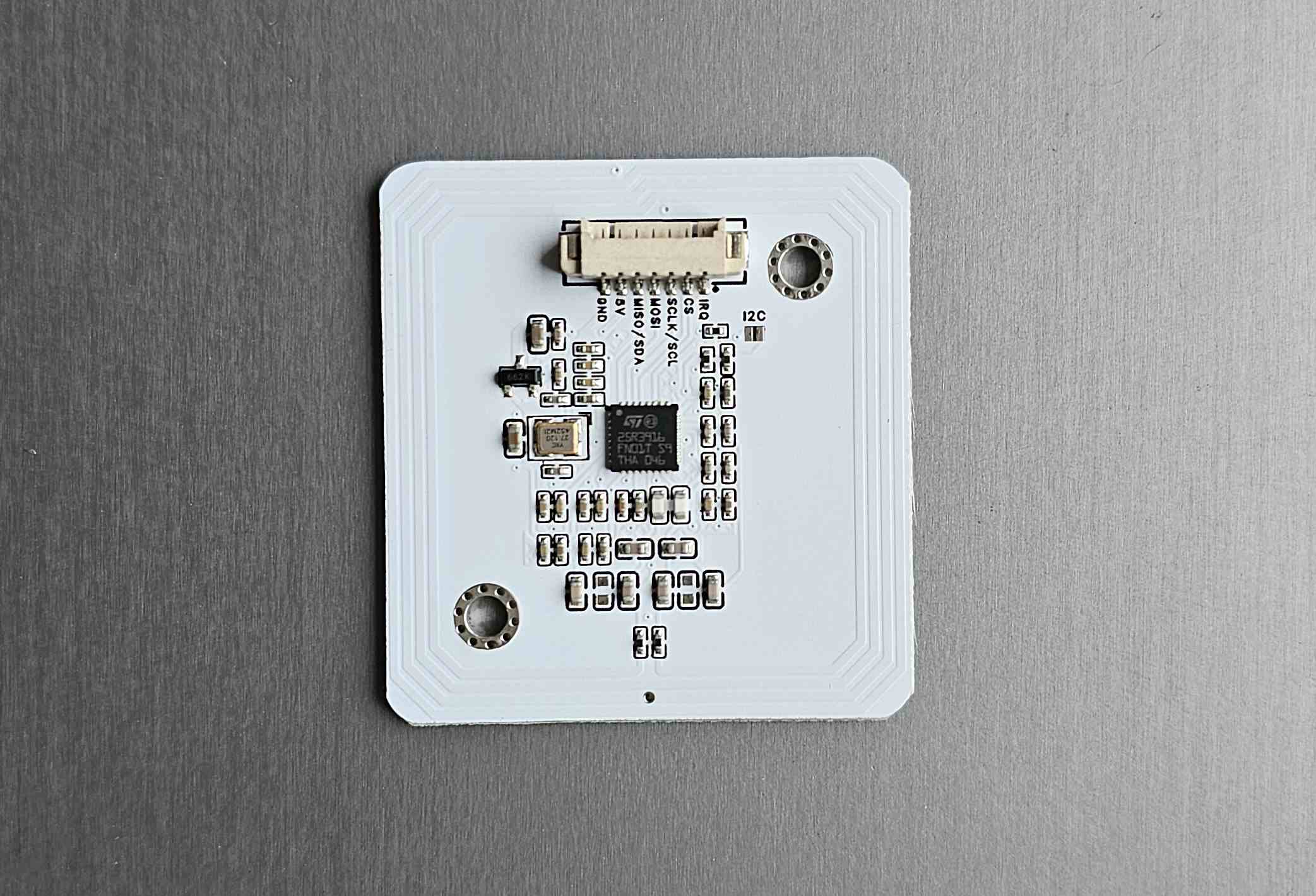
| Pin | Description |
| 5V | Power input |
| GND | Ground |
| MOSI | SPI data from host to module |
| MISO | SPI data from module to host |
| SCK | SPI clock |
| CS | SPI chip select |
| IRQ | Interrupt output |
| SDA | I2C data line after switching to I2C mode |
| SCL | I2C clock line after switching to I2C mode |
Default quick start uses SPI. If you switch the board to I2C mode, the main host signals become SDA, SCL, IRQ, 5V, and GND.
I2C Mode Support
This module works in SPI mode by default. It can also be used in I2C mode after a small hardware change on the board.
To switch the module to I2C mode, bridge the on-board pad marked I2C as shown in the product image. Without this bridge, the module remains in default SPI mode.
- Bridge the on-board I2C solder pad on the module.
- Connect the module using SDA / SCL / IRQ / VCC / GND.
- Use the latest ELECHOUSE library and I2C examples from GitHub.
GitHub Library: https://github.com/wilson-elechouse/ST25R3916
Default ESP32 I2C Wiring
- SDA -> GPIO21
- SCL -> GPIO22
- IRQ -> GPIO4
- LED -> GPIO2 (optional)
- I2C clock -> 100 kHz recommended for bring-up
Current I2C Examples in the Latest Library
- ESP32_I2C_probe_chip – raw ACK, chip ID, and initialization test
- ESP32_I2C_scan_14443A – basic ISO14443A card detection
- ESP32_I2C_scan_14443A_15693 – extended scan example
- ESP32_I2C_polling_hotplug – continuous polling with insert/remove reporting
- ESP32_I2C_mf1_s70_read_write_test – MIFARE Classic S70 read/write test over I2C
Note: SPI is still the recommended quick-start path. I2C is provided for users who need a two-wire host interface and are comfortable changing the board solder pad.
Reading Distance Test Results
All tests performed with the on-board integrated PCB antenna under standard conditions:
| Tag Type | Standard | Chip / Tag | Card Size (cm) | Read Distance (cm) |
|---|---|---|---|---|
| NFC Type 1 Tag | ISO 14443A | Topaz 512 | 8.5 × 5.4 | 5.5 |
| NFC Type 2 Tag | ISO 14443A | NTAG213 | 8.5 × 5.4 | 6.5 |
| NFC Type 2 Tag | ISO 14443A | NTAG216 | 8.5 × 5.4 | 6.5 |
| NFC Type 3 Tag | JIS X 6319-4 | FeliCa | 8.5 × 5.4 | 5.0 |
| NFC Type 4 Tag (DESFire) | ISO 14443-4 | MIFARE DESFire 4K/8K | 8.5 × 5.4 | 2.8 |
| NFC Type 4 Tag (NTAG424 DNA) | ISO 14443A | NTAG424 DNA | 8.5 × 5.4 | 5.0 |
| NFC Type 4 Tag (ISO 14443-4B) | ISO 14443-4B | – | 8.5 × 5.4 | 2.3 |
| NFC Type 5 Tag | ISO 15693 | ICODE SLI-S | 8.5 × 5.4 | 9.5 |
| NFC Type 5 Tag (I CODE SLIX2) | ISO 15693 | I CODE SLIX2 | 8.5 × 5.4 | 11.0 |
| NFC Type 5 Tag (I CODE SLI-X) | ISO 15693 | I CODE SLI-X | 8.5 × 5.4 | 9.5 |
| Anti-Metal Tag (F08) | ISO 14443A | MIFARE Classic | 5 × 5 | 2.2 |
| Anti-Metal Tag (F08, round) | ISO 14443A | MIFARE Classic | Ø 3 | 0.9 |
| Anti-Metal Tag (NTAG213) | ISO 14443A | NTAG213 | 4 × 2.5 | 2.2 |
| Anti-Metal Tag (ISO 15693) | ISO 15693 | – | 4 × 2.5 | 2.3 |
Typical Use Cases
- High-performance NFC readers for access control and identification
- ISO 15693 long-range tag reading for inventory and asset tracking
- MIFARE DESFire secure card applications
- NFC antenna testing and protocol research
- Industrial NFC reading in demanding environments
Quick Start
- Use the module in default SPI mode for the fastest setup, or bridge the I2C pad if you need I2C mode.
- Open the documentation links in the Downloads section.
- Refer to the schematic PDF for pinout and wiring reference.
- Run the provided SPI or I2C examples to verify connectivity and detect a tag.
Frequently Asked Questions
- What is the maximum reading distance?
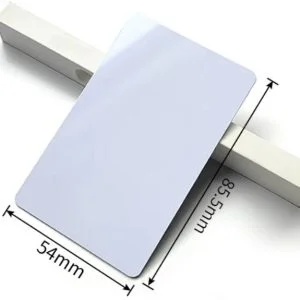
- Up to 11 cm with an I CODE SLIX2 tag (ISO 15693, 85×54 mm). Distance varies by tag type and environment.
- Does it work with standard MIFARE cards?
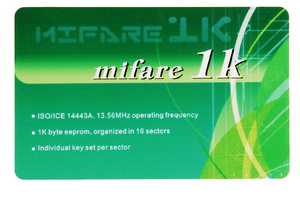
- Yes. MIFARE Classic 1K/4K, Ultralight, and DESFire are supported via ISO 14443A.
- What interface does it use?
- The module uses SPI by default. It also supports I2C after bridging the on-board I2C solder pad.
- Do I need to modify the board to use I2C?
- Yes. To use I2C mode, you must bridge the pad marked I2C on the module.
- Which interface should I use first?
- SPI is recommended for first-time testing. Use I2C when you need a two-wire host interface and are comfortable modifying the hardware pad.
- How do I switch the module to I2C?
- Bridge the pad marked I2C on the board, then wire the module using SDA, SCL, IRQ, VCC, and GND. After that, use the I2C examples from the latest ELECHOUSE GitHub library.
- Does the library include both SPI and I2C examples?
- Yes. The latest ELECHOUSE ST25R3916 library includes both SPI and I2C examples for ESP32.
- Can it do card emulation?
- Yes. The ST25R3916 supports NFC-A and NFC-F card emulation at IC level. Application behavior depends on the firmware/software implementation.
- How does it compare to the PN532 or PN7160?
- The ST25R3916 typically offers longer reading range and broader tag type support, particularly for ISO 15693. The PN532 is simpler to use with Arduino. The PN7160 has native Linux and Android driver support. See the comparison page for details.
Compare This Module
Downloads
- ESP32 SPI Test Guide
- ESP32 I2C Quick Start
- Latest GitHub Library (SPI + I2C examples)
- PDF Schematic (reference only)
- 3D Dimension File
- CE Certificate
- RoHS Certificate
Related Documentation and Selection Guides
- ST25R3916 Documentation
- PN532 vs PN7160 vs ST25R3916
- Best NFC Module for Arduino
- Best NFC Module for Raspberry Pi / Linux
- Best NFC Module for ESP32
- NFC for Access Control
- NFC for IoT & Smart Home
- Connector Selection Guide
OEM / Custom Orders
ELECHOUSE provides OEM and ODM services for this module. Learn more or contact us.
RFID & NFC Module Selection Guide
Not sure which module fits your project? See the full comparison with protocol support, interface options, and use case guidance in our RFID & NFC Module Selection Guide.